Sign Language Learning Game Web App: An Interactive Approach to Inclusive Digital Education
Table of Contents
- Sign Language Learning Game Web App: An Interactive Approach to Inclusive Digital Education
- The Need for Sign Language Education
- Why a Game-Based Approach?
- Overview of the Web Application
- Core Objectives of the System
- Key Features of the Platform
- 1. Interactive Lessons
- 2. Game Levels and Challenges
- 3. Score and Reward System
- 4. User Accounts and Progress Tracking
- 5. Accessibility-Focused Interface
- Technology Stack for Development
- Frontend Technologies
- Backend Technologies
- Database Structure
- How the Learning Process Works
- Educational Impact
- 1. Promoting Inclusive Communication
- 2. Supporting Self-Paced Learning
- 3. Increasing Accessibility to Education
- 4. Encouraging Early Awareness
- Possible Advanced Features
- 1. Camera-Based Sign Recognition
- 2. Multiplayer or Cooperative Learning
- 3. Mobile App Integration
- Challenges in Development
- 1. Accurate Sign Representation
- 2. User Engagement
- 3. Accessibility Compliance
- 4. Performance Optimization
- Best Practices for Development
- Future Opportunities
- Conclusion
In today’s fast-paced digital world, learning is no longer limited to classrooms, textbooks, and lectures. Technology has opened the doors to interactive and engaging learning experiences that reach people of all backgrounds. One meaningful application of this shift is the Sign Language Learning Game Web App—an online platform designed to make sign language education more accessible, enjoyable, and effective.
This project merges the fields of information technology, education, and assistive communication. It demonstrates how web-based systems can be designed not only for convenience and entertainment, but also for social impact.
The Need for Sign Language Education
Sign language plays a vital role in the lives of deaf and hard-of-hearing individuals. It is not just a communication tool—it is a language with its own grammar, structure, and cultural significance. Unfortunately, many hearing individuals have limited exposure to sign language. This communication gap can lead to misunderstandings, isolation, and reduced opportunities for inclusion.
Traditional sign language learning methods usually involve:
- Face-to-face classes
- Printed visual guides
- Instructional videos
While these methods are effective, they may not always be accessible due to time, cost, or geographic limitations. This is where a web-based learning platform becomes valuable. By making sign language lessons available online, learners can study anytime, anywhere.
Why a Game-Based Approach?
Gamification is a popular strategy in modern educational systems. It involves applying game elements—such as points, levels, rewards, and challenges—into non-game contexts to motivate users.
A sign language learning game offers several advantages:
- Increased engagement
Learners are more likely to stay motivated when the process feels like playing rather than studying. - Immediate feedback
Players receive instant responses to their actions, helping them correct mistakes quickly. - Progress tracking
Game levels and scores help learners see their improvement over time. - Reduced learning anxiety
Games create a relaxed environment, making it easier for beginners to experiment and learn.
Instead of memorizing signs from a book, users interact with the platform, complete challenges, and earn rewards while learning new gestures.
Overview of the Web Application
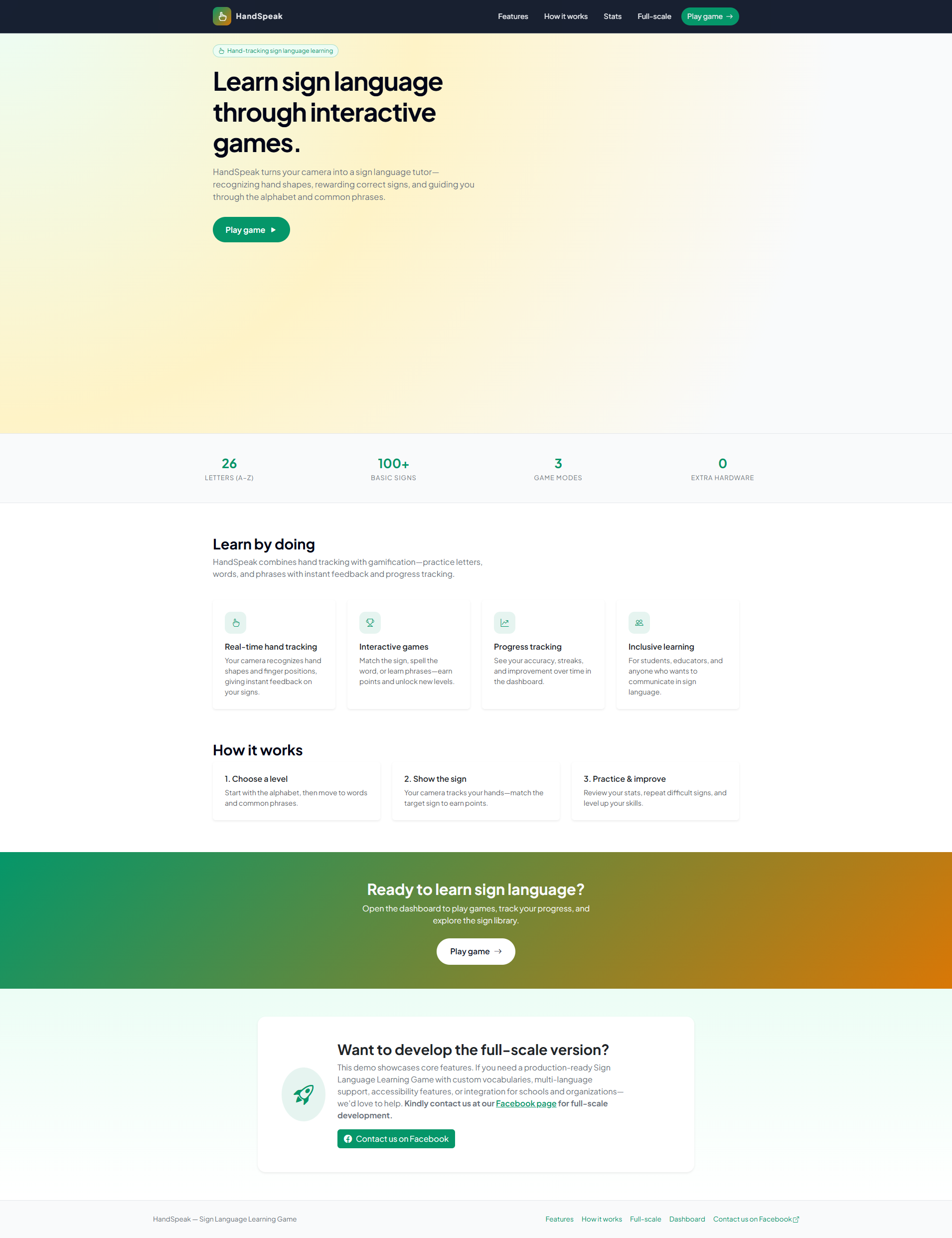
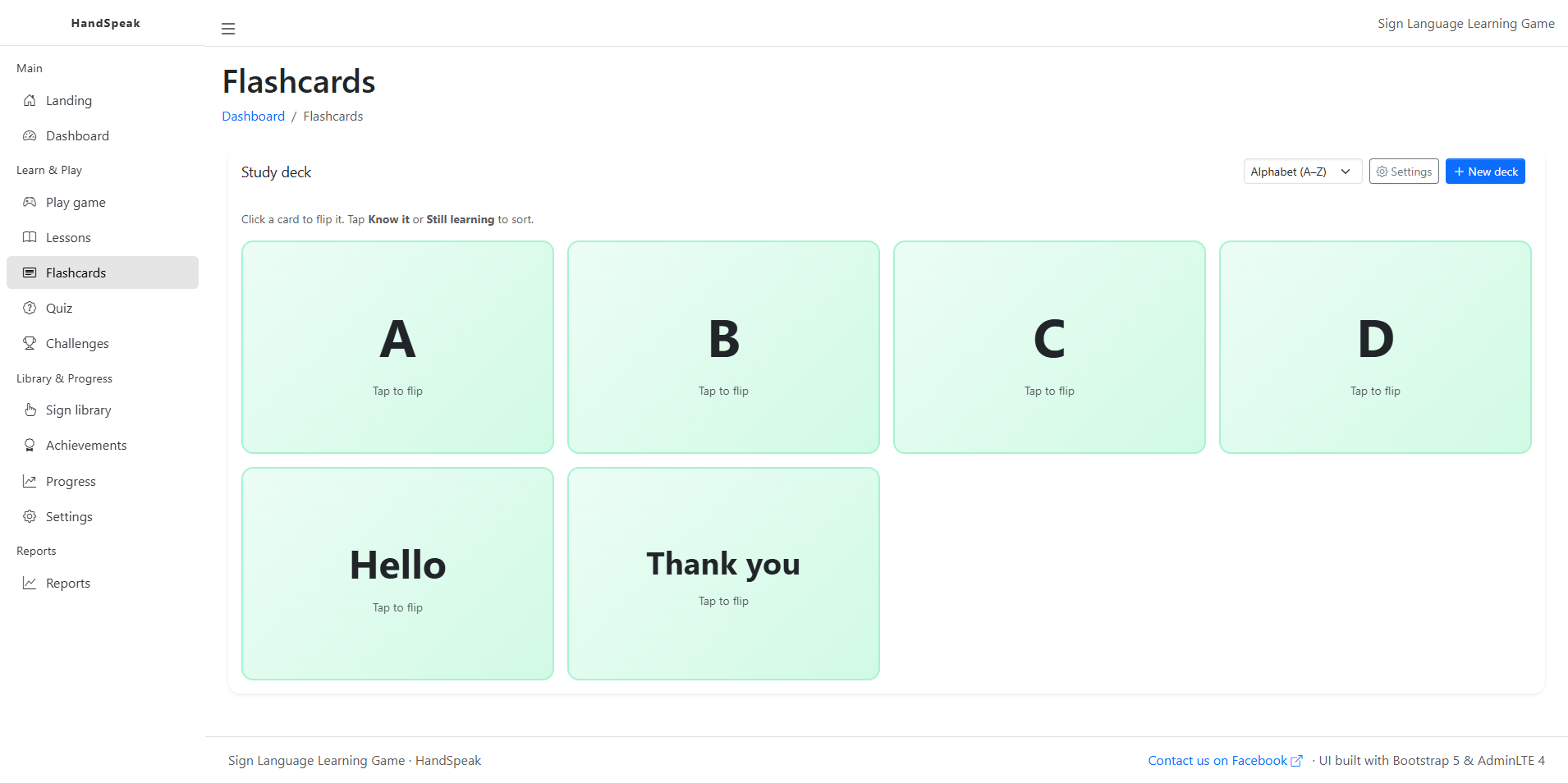
The Sign Language Learning Game Web App is an online platform designed to teach basic to intermediate sign language through interactive activities. It can be accessed through a web browser on desktops, laptops, tablets, or smartphones.
Core Objectives of the System
The main goals of the system include:
- Promoting awareness of sign language
- Providing a fun and interactive learning experience
- Supporting inclusive communication
- Offering a free or low-cost alternative to traditional classes
Key Features of the Platform
1. Interactive Lessons
The platform provides structured lessons that introduce:
- Alphabet signs
- Numbers
- Common words
- Everyday phrases
Each lesson includes visual demonstrations, such as:
- Animated hand gestures
- Short video clips
- Step-by-step sign instructions
2. Game Levels and Challenges
To maintain user interest, the system organizes lessons into levels. Each level focuses on a specific set of signs or themes.
Examples of game challenges include:
- Matching signs to words
- Multiple-choice quizzes
- Timed recognition games
- Drag-and-drop exercises
As players progress, the difficulty gradually increases.
3. Score and Reward System
Gamification elements are integrated into the platform to encourage continuous learning. These include:
- Points for correct answers
- Badges for completed levels
- Achievement milestones
- Leaderboards (optional feature)
Rewards help maintain motivation and give learners a sense of accomplishment.
4. User Accounts and Progress Tracking
Registered users can:
- Create personal accounts
- Track their lesson progress
- View scores and achievements
- Resume lessons where they left off
This feature is especially useful for students using the platform regularly.
5. Accessibility-Focused Interface
Since the platform is designed with inclusivity in mind, the interface emphasizes:
- Clear visual instructions
- Minimal reliance on audio
- High-contrast color schemes
- Simple navigation
This ensures that both deaf and hearing users can comfortably use the system.
Technology Stack for Development
Developing a sign language learning web app involves several components. A typical IT stack for this type of system might include:
Frontend Technologies
- HTML for page structure
- CSS or Bootstrap for styling and responsiveness
- JavaScript for interactive elements
Optional enhancements:
- Animation libraries for hand gestures
- Canvas or SVG for interactive sign displays
Backend Technologies
- PHP for server-side logic
- MySQL for database management
- MVC architecture for structured development
The backend handles:
- User authentication
- Progress tracking
- Score calculations
- Content management
Database Structure
The database may include tables such as:
- Users
- Lessons
- Signs
- Game levels
- Scores
- Achievements
A well-structured database ensures efficient data retrieval and system performance.
How the Learning Process Works
A typical user journey in the platform might look like this:
- The user registers or logs in.
- They select a lesson or start from Level 1.
- The system introduces a set of signs.
- The user practices through interactive challenges.
- The system provides instant feedback.
- The user earns points and unlocks the next level.
This cycle continues, gradually expanding the learner’s vocabulary and comprehension.
Educational Impact
A sign language learning web app can have a meaningful social impact. Some of its benefits include:
1. Promoting Inclusive Communication
When more people learn sign language, communication barriers decrease. This helps create more inclusive schools, workplaces, and communities.
2. Supporting Self-Paced Learning
Unlike traditional classes, a web app allows users to learn at their own speed. They can repeat lessons, skip ahead, or review difficult signs.
3. Increasing Accessibility to Education
Not everyone has access to sign language teachers or institutions. An online platform provides a practical alternative.
4. Encouraging Early Awareness
Game-based learning is especially effective for children. Introducing sign language through games helps them develop empathy and communication skills at an early age.
Possible Advanced Features
As the system evolves, several advanced features can be added.
1. Camera-Based Sign Recognition
Using computer vision, the app could analyze hand gestures through a webcam. The system would:
- Detect the user’s hand position
- Compare it with the correct sign
- Provide feedback on accuracy
This would simulate real-life practice with an instructor.
2. Multiplayer or Cooperative Learning
Users could:
- Compete in sign recognition games
- Practice conversations
- Join group challenges
This adds a social dimension to the learning process.
3. Mobile App Integration
Although the system is web-based, it can be converted into:
- A Progressive Web App (PWA)
- A native Android or iOS app
This improves accessibility for users who rely primarily on smartphones.
Challenges in Development
Like any IT project, this platform comes with certain challenges.
1. Accurate Sign Representation
Signs must be displayed clearly and correctly. Poor animations or incorrect gestures can mislead learners.
2. User Engagement
If the game mechanics are too simple or repetitive, users may lose interest. Balancing education and entertainment is crucial.
3. Accessibility Compliance
The platform must follow accessibility standards to ensure it is usable by people with different needs.
4. Performance Optimization
Since the app relies on images, videos, or animations, performance must be optimized to avoid slow loading times.
Best Practices for Development
To build an effective sign language learning game web app, developers should consider the following:
- Use simple, intuitive navigation
- Keep the interface visually clear
- Provide instant feedback for actions
- Design levels with gradual difficulty
- Test the system with real users
User testing is especially important. Feedback from both deaf and hearing users can help refine the platform.
Future Opportunities
This type of system opens the door to many future innovations, such as:
- Integration with educational institutions
- Certification programs for learners
- AI-powered sign language tutors
- Real-time translation tools
As artificial intelligence and computer vision technologies continue to improve, sign language learning platforms will become even more interactive and accurate.
Conclusion
The Sign Language Learning Game Web App represents a meaningful blend of technology, education, and social responsibility. By transforming sign language lessons into interactive games, the platform makes learning more engaging and accessible for everyone.
From an IT perspective, this project demonstrates how web technologies can be used to create solutions that go beyond convenience and entertainment. It shows that software development can play a key role in promoting inclusivity and bridging communication gaps.
In the long run, projects like this do more than teach a language—they help build a more understanding and connected society.
You may visit our Facebook page for more information, inquiries, and comments. Please subscribe also to our YouTube Channel to receive free capstone projects resources and computer programming tutorials.
Hire our team to do the project.