Rehabilitation Monitoring System Using PoseNet: A Complete Guide to AI-Driven Physical Therapy
Table of Contents
- Rehabilitation Monitoring System Using PoseNet: A Complete Guide to AI-Driven Physical Therapy
- What Is Rehabilitation Monitoring?
- Introducing PoseNet
- How PoseNet Enhances Rehabilitation Monitoring
- 1. Real-Time Posture Analysis
- 2. Range of Motion (ROM) Measurement
- 3. Automated Repetition Counting
- 4. Correction Feedback
- 5. Performance Scoring
- 6. Progress Tracking
- System Architecture of the Rehabilitation Monitoring System
- 1. Input Layer
- 2. Pose Estimation Layer (PoseNet)
- 3. Feature Extraction
- 4. Exercise Evaluation Module
- 5. Feedback System
- 6. Data Storage
- 7. Dashboard or App Interface
- Key Features Extracted Using PoseNet for Rehabilitation
- Joint Angles
- Range of Motion
- Body Symmetry
- Velocity and Smoothness
- Posture Stability
- Applications in Healthcare and Physical Therapy
- 1. Home-Based Therapy
- 2. Tele-Rehabilitation
- 3. Orthopedic Recovery
- 4. Neurological Rehabilitation
- 5. Balance and Fall Prevention
- 6. Sports Injury Rehabilitation
- Benefits of Using PoseNet in Rehabilitation
- Limitations and Challenges
- 1. Works in 2D Only
- 2. Sensitive to Lighting and Camera Angles
- 3. Patient Positioning Requirements
- 4. Privacy Considerations
- 5. Movement Complexity
- Enhancing the System (Future Improvements)
- 1. Use 3D Pose Models
- 2. Machine Learning Classifiers
- 3. Integrate with Mobile Apps
- 4. Add Audio Coaching
- 5. VR and AR Integration
- Example Implementation Snippet
- Conclusion
Recovering from injuries, surgeries, or neurological conditions often requires patients to undergo rehabilitation exercises consistently and accurately. Traditionally, therapists evaluate patient performance manually—observing posture, limb angles, movement speed, and range of motion. While effective, this method is time-consuming, subjective, and difficult to scale, especially during remote sessions.
Thanks to advancements in computer vision, AI-powered systems can now monitor, evaluate, and guide rehabilitation exercises. One technology that stands out is PoseNet, a lightweight human pose estimation model capable of detecting 17 body keypoints in real-time. In this blog post, we explore how PoseNet can be used to build a Rehabilitation Monitoring System, its architecture, benefits, limitations, and how developers can start implementing it.
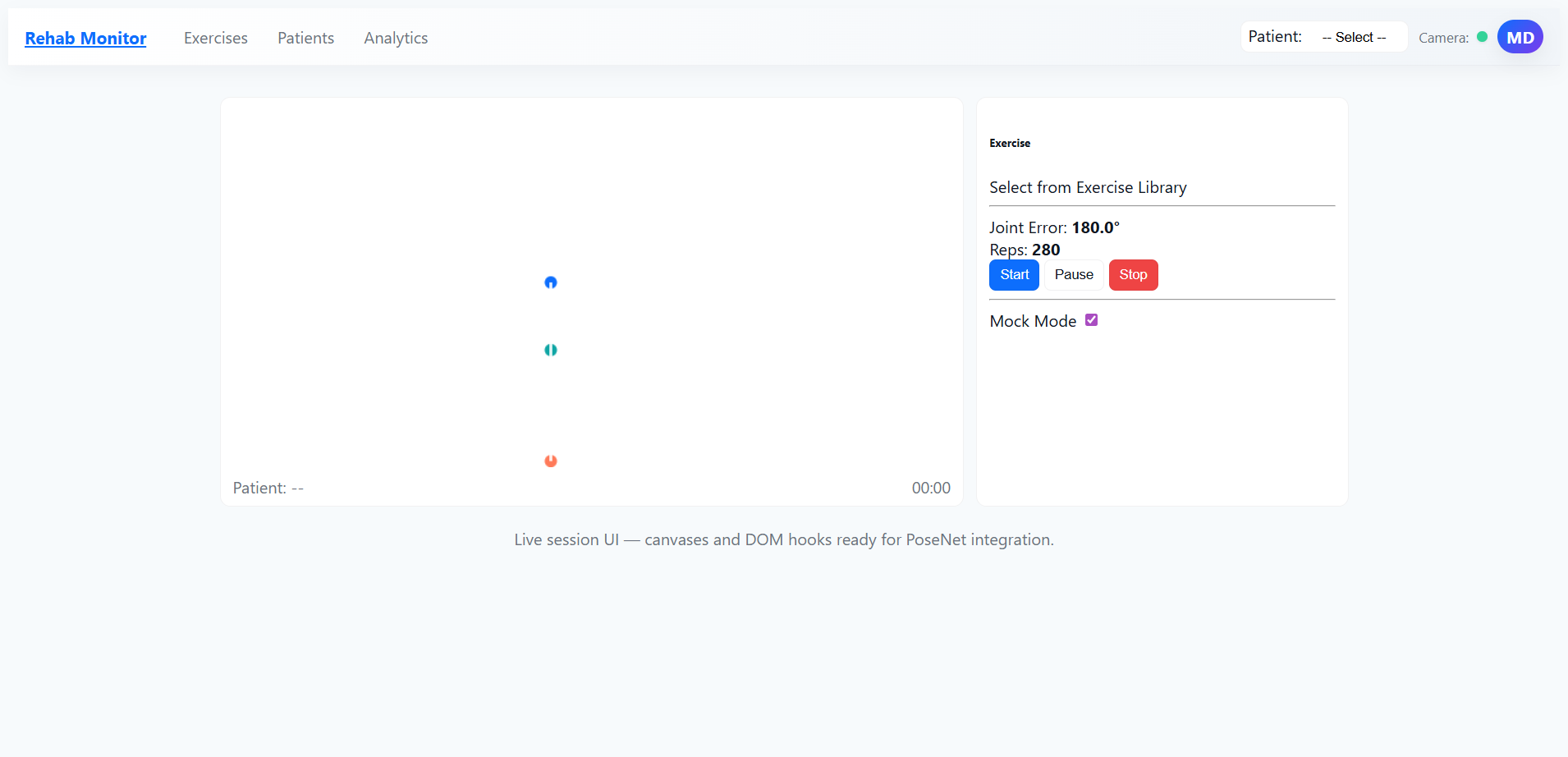
What Is Rehabilitation Monitoring?
Rehabilitation monitoring refers to the continuous assessment of a patient’s movements during physical therapy. It ensures:
- Correct execution of exercises
- Accurate tracking of progress
- Reduced risk of injury or incorrect form
- Enhanced therapist productivity
- Improved patient engagement, especially during home-based therapy
This type of monitoring is crucial for:
- Post-surgery recovery
- Orthopedic rehabilitation (knee, shoulder, back)
- Stroke and neurological rehabilitation
- Elderly mobility and balance training
- Sports injury recovery
A digital monitoring system powered by PoseNet can greatly improve the accuracy and accessibility of rehabilitation programs.
Introducing PoseNet
PoseNet is a machine learning model that detects human poses by identifying 17 body keypoints, including:
- Nose, eyes, ears
- Shoulders, elbows, wrists
- Hips, knees, ankles
It works efficiently on:
- Laptops
- Smartphones
- Browsers (via TensorFlow.js)
- Low-power devices
Its real-time capabilities make PoseNet ideal for exercise tracking and rehabilitation analysis.
How PoseNet Enhances Rehabilitation Monitoring
PoseNet’s ability to detect joint movement makes it possible to automate many physical therapy tasks, including:
1. Real-Time Posture Analysis
The system identifies whether the patient is performing the exercise correctly by checking:
- Joint alignment
- Limb angles
- Body symmetry
2. Range of Motion (ROM) Measurement
PoseNet can track improvements in flexibility and strength by measuring:
- Knee bending angle
- Arm lifting height
- Hip rotation
- Torso stability
3. Automated Repetition Counting
Using keypoint movement deltas, the system counts:
- Reps and sets
- Tempo and speed
- Rest periods
4. Correction Feedback
Real-time alerts can notify the patient:
- “Raise your arm higher”
- “Straighten your back”
- “Extend your knee fully”
5. Performance Scoring
The system can calculate:
- Accuracy score per repetition
- Smoothness of movement
- Timing consistency
6. Progress Tracking
All results are recorded and displayed in:
- Therapist dashboards
- Patient mobile apps
This transforms traditional therapy into a modern, data-driven process.
System Architecture of the Rehabilitation Monitoring System
A PoseNet-powered rehabilitation system typically includes:
1. Input Layer
- Webcam, smartphone camera, or clinic camera
- Video capture in real time
2. Pose Estimation Layer (PoseNet)
- Detects human keypoints
- Computes joint locations and confidence levels
3. Feature Extraction
Key values derived from pose coordinates:
- Joint angles (elbow, knee, hip)
- Vertical/horizontal posture alignment
- Movement velocity
- Balance indicators
4. Exercise Evaluation Module
- Compares user movement to “ideal” patterns
- Uses rules or machine learning classifiers to detect errors
- Decides whether a repetition is valid
5. Feedback System
- On-screen notifications
- Audio or vibration alerts
- Real-time corrections
6. Data Storage
Stores:
- Daily performance
- Angle measurements
- Completed exercises
7. Dashboard or App Interface
For therapists and patients to view:
- Progress charts
- Session history
- Mobility improvements
- Alerts
Key Features Extracted Using PoseNet for Rehabilitation
Here are the main motion metrics PoseNet can measure:
Joint Angles
- Elbow flexion/extension
- Shoulder rotation
- Knee extension
- Hip abduction
Range of Motion
Useful for measuring flexibility improvements.
Body Symmetry
Compares left and right limbs for:
- Balance
- Equal strength
- Correct form
Velocity and Smoothness
Detect issues in motor control (especially for stroke rehabilitation).
Posture Stability
Detects wobbling, leaning, or incorrect weight shifting.
Applications in Healthcare and Physical Therapy
PoseNet-based rehabilitation systems can be used in:
1. Home-Based Therapy
Patients can practice exercises without a therapist present.
2. Tele-Rehabilitation
Therapists can remotely monitor patients with real-time insights.
3. Orthopedic Recovery
After ACL surgery, shoulder surgeries, or fractures.
4. Neurological Rehabilitation
Useful for:
- Stroke recovery
- Parkinson’s disease monitoring
- Motor skill retraining
5. Balance and Fall Prevention
Especially for elderly individuals.
6. Sports Injury Rehabilitation
Athletes can track progress precisely.
Benefits of Using PoseNet in Rehabilitation
- Non-invasive – no wearables needed
- Affordable – runs on consumer devices
- Real-time feedback improves accuracy
- Scalable for clinics and remote patients
- Objective measurement replaces guesswork
- Enhanced patient motivation through visual progress tracking
- Reduces therapist workload
Limitations and Challenges
Like any technology, PoseNet has limits:
1. Works in 2D Only
Complex 3D movements may be harder to track.
2. Sensitive to Lighting and Camera Angles
May reduce accuracy.
3. Patient Positioning Requirements
Users must stay within camera view.
4. Privacy Considerations
Medical data must be securely stored and transmitted.
5. Movement Complexity
Highly dynamic motions may require more advanced models (MoveNet, BlazePose).
Enhancing the System (Future Improvements)
To make the system more powerful:
1. Use 3D Pose Models
BlazePose GHUM or MoveNet 3D for higher accuracy.
2. Machine Learning Classifiers
For advanced exercise recognition.
3. Integrate with Mobile Apps
Flutter or React Native for patients at home.
4. Add Audio Coaching
Voice instructions based on keypoint changes.
5. VR and AR Integration
Immersive rehabilitation sessions with guided overlays.
Example Implementation Snippet
Below is a simple PoseNet example using TensorFlow.js:
const net = await posenet.load();
const poses = await net.estimateSinglePose(videoElement);

// Sample angle computation
function getAngle(A, B, C) {
  const AB = { x: B.x - A.x, y: B.y - A.y };
  const CB = { x: B.x - C.x, y: B.y - C.y };
  const dot = AB.x * CB.x + AB.y * CB.y;
  const magAB = Math.sqrt(AB.x**2 + AB.y**2);
  const magCB = Math.sqrt(CB.x**2 + CB.y**2);
  return Math.acos(dot / (magAB * magCB)) * (180 / Math.PI);
}
This function can measure elbow, shoulder, or knee angles, which form the basis of the rehabilitation scoring system.
Conclusion
A Rehabilitation Monitoring System using PoseNet offers a modern, accurate, and scalable way to transform physical therapy. By detecting posture, joint movement, angles, and progress over time, PoseNet empowers both therapists and patients to achieve better recovery outcomes.
As AI continues to evolve, we can expect even more intelligent features such as personalized exercise plans, automated diagnosis of movement disorders, and immersive AR-based rehabilitation experiences.
PoseNet represents a major step forward in accessible and effective rehab technology—and the future looks even brighter.
You may visit our Facebook page for more information, inquiries, and comments. Please subscribe also to our YouTube Channel to receive free capstone projects resources and computer programming tutorials.
Hire our team to do the project.