Online Barter System with AI Integration: Reinventing Digital Exchange Through Smart Technology
Table of Contents
- Online Barter System with AI Integration: Reinventing Digital Exchange Through Smart Technology
- Why a Digital Barter Platform?
- The Role of Artificial Intelligence
- Core Objectives of the Online Barter System
- System Overview: How the Platform Works
- Step-by-Step User Flow
- Key Features of the Platform
- 1. User Registration and Profile Management
- 2. Smart Item Listings
- 3. AI-Based Matching Algorithm
- 4. Trade Value Estimation
- 5. Messaging and Negotiation Module
- 6. Rating and Reputation System
- Technology Stack for Development
- Frontend Technologies
- Backend Technologies
- AI and Machine Learning Layer
- Database Design Considerations
- Security and Privacy Considerations
- Benefits of an AI-Powered Barter Platform
- 1. Increased Match Efficiency
- 2. Fairer Trade Decisions
- 3. Enhanced User Trust
- 4. Sustainability Impact
- Challenges in Development
- 1. Matching Complexity
- 2. Cold Start Problem
- 3. User Adoption
- 4. Logistics Coordination
- Future Enhancements
- Business and Academic Potential
- Conclusion
In a world dominated by cashless payments, digital wallets, and e-commerce platforms, it is easy to forget that trade existed long before money. Barter—the direct exchange of goods and services—was one of the earliest forms of economic activity. Surprisingly, the concept still holds value today, especially in communities looking for sustainable, low-cost alternatives to traditional buying and selling.
The Online Barter System with AI Integration brings this ancient economic model into the modern digital landscape. By combining web development technologies with artificial intelligence, this platform creates a smart, secure, and efficient environment for peer-to-peer item exchange.
This is not simply a listing website. It is an intelligent platform designed to automate matching, enhance trust, and optimize user experience through data-driven decision-making.
Why a Digital Barter Platform?
Modern consumers are becoming more conscious of sustainability, affordability, and resource optimization. Many people have unused items at home—books, gadgets, tools, clothes—that could be exchanged rather than discarded or sold at minimal value.
However, traditional barter faces challenges:
- Difficulty finding matching needs
- Trust and verification issues
- Time-consuming negotiations
- Limited reach within small communities
A web-based barter platform addresses these challenges by providing:
- A searchable item database
- User authentication
- Automated matching
- Transaction tracking
When AI is integrated, the system becomes even more efficient.
The Role of Artificial Intelligence
AI transforms the barter process from manual searching into intelligent recommendation.
Instead of users endlessly browsing listings, the system can:
- Analyze user preferences
- Detect trade compatibility
- Suggest optimal exchange partners
- Estimate item value equivalence
- Flag suspicious or fraudulent behavior
This significantly improves transaction success rates.
Core Objectives of the Online Barter System
The platform is designed to:
- Facilitate peer-to-peer exchange of goods and services
- Use AI to recommend fair and relevant trades
- Provide a secure environment for users
- Encourage sustainable consumption
- Deliver a seamless and user-friendly experience
This makes the system suitable as an IT capstone project, startup prototype, or research-based platform.
System Overview: How the Platform Works
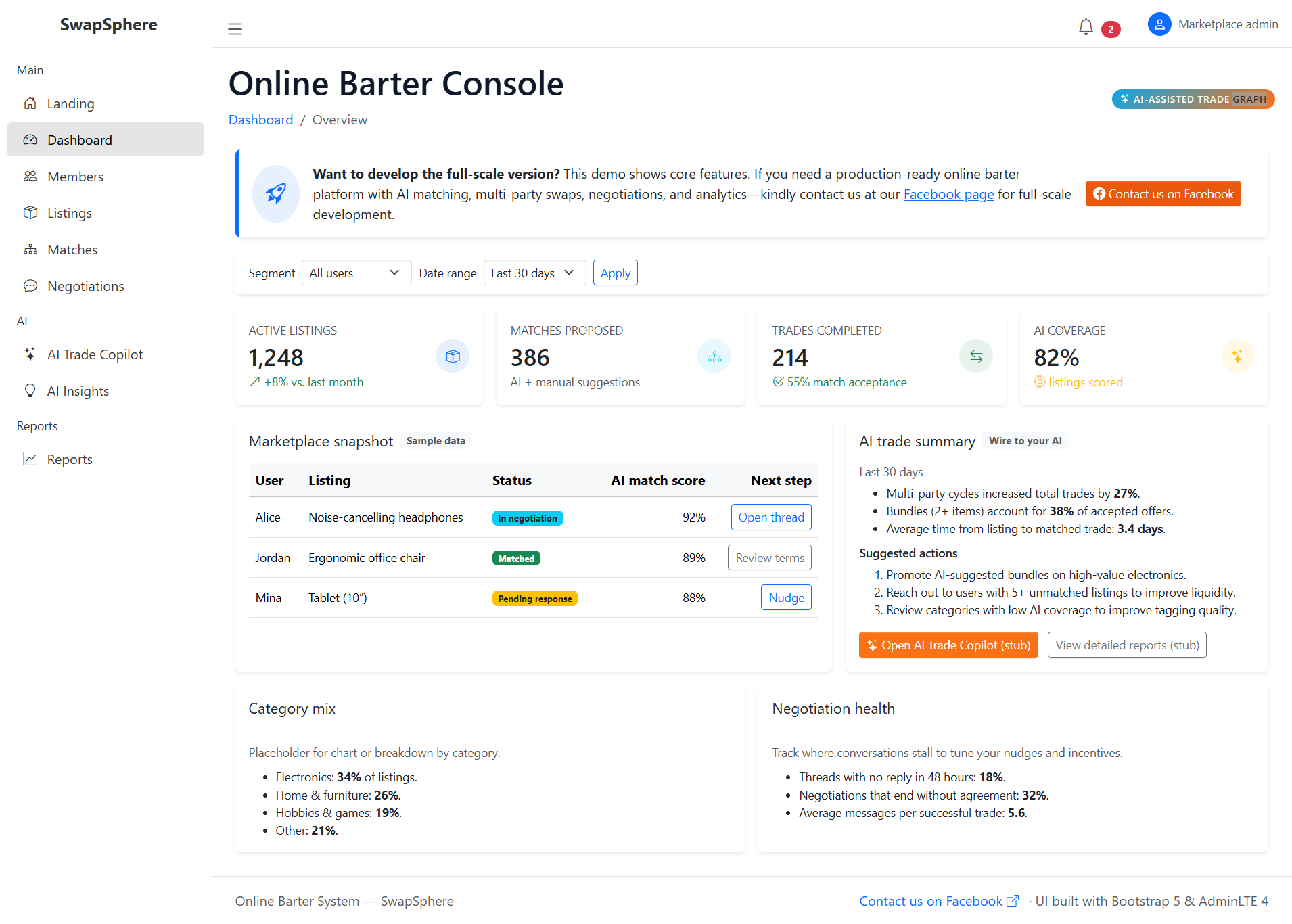
The Online Barter System operates as a structured web application where users can register, list items, browse offers, and negotiate exchanges.
Step-by-Step User Flow
- User creates an account.
- User lists an item with description, images, and estimated value.
- The AI engine analyzes the listing.
- The system suggests potential trade matches.
- Users negotiate and confirm exchange terms.
- Transaction status is updated and recorded.
The integration of AI ensures that suggestions are not random but data-driven.
Key Features of the Platform
1. User Registration and Profile Management
Each user has a secure account that stores:
- Personal information
- Transaction history
- Ratings and feedback
- Item listings
Authentication mechanisms may include:
- Email verification
- Two-factor authentication
- Encrypted passwords
Trust is critical in peer-to-peer platforms.
2. Smart Item Listings
Users can upload:
- Item images
- Detailed descriptions
- Category tags
- Estimated value
- Condition status
AI tools can assist by:
- Automatically categorizing items
- Detecting duplicate listings
- Suggesting appropriate value ranges
This reduces manual errors and improves listing quality.
3. AI-Based Matching Algorithm
The intelligent matching engine is the core of the system.
Instead of simple keyword matching, the algorithm can analyze:
- User trade preferences
- Item categories
- Historical transaction patterns
- Geographic proximity
- Value compatibility
For example:
If User A lists a laptop and wants a smartphone, and User B lists a smartphone and wants electronics, the system identifies this mutual compatibility and suggests a trade.
More advanced versions can support multi-party trades where three or more users complete a circular exchange.
4. Trade Value Estimation
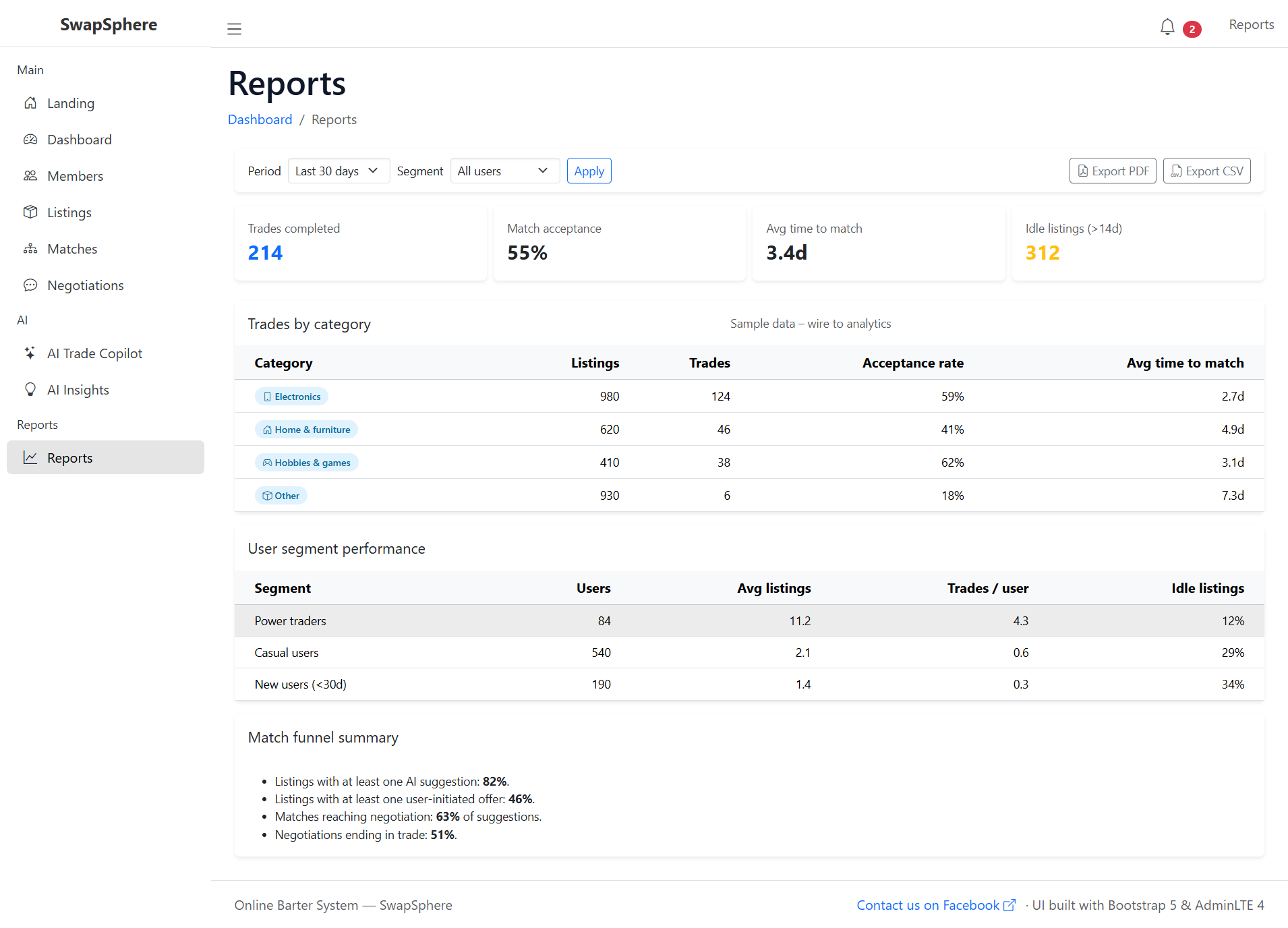
One of the biggest challenges in barter is determining fairness.
AI can help by:
- Analyzing historical exchange data
- Comparing similar items
- Suggesting fair trade equivalents
- Providing a trade balance indicator
For example, if a laptop is significantly higher in value than a phone, the system may recommend additional items to balance the exchange.
5. Messaging and Negotiation Module
Users can communicate through an internal chat system to:
- Discuss item conditions
- Negotiate terms
- Arrange delivery or meet-up
All communications remain within the platform for security and moderation.
6. Rating and Reputation System
After completing a trade, users can rate each other.
The reputation score influences:
- Visibility in search results
- Trade recommendations
- Trust level within the system
AI can also analyze patterns to detect fake reviews or suspicious behavior.
Technology Stack for Development
Developing this platform requires careful system design.
Frontend Technologies
- HTML5 for structural layout
- CSS3 or Bootstrap for responsive design
- JavaScript for dynamic interaction
- AJAX for real-time updates
The interface must be clean, intuitive, and optimized for both desktop and mobile devices.
Backend Technologies
- PHP (native or MVC-based architecture) or Node.js
- MySQL or PostgreSQL for relational data storage
- RESTful API design for communication
Backend responsibilities include:
- User authentication
- Trade processing
- AI model integration
- Notification handling
AI and Machine Learning Layer
The AI component may use:
- Python-based machine learning libraries
- Recommendation system algorithms
- NLP for analyzing item descriptions
- Anomaly detection models for fraud prevention
The AI engine can operate as:
- A microservice
- A cloud-based API
- An integrated backend module
Database Design Considerations
A structured database is essential for performance and scalability.
Possible tables include:
- Users
- Items
- TradeRequests
- Messages
- Ratings
- AIRecommendations
- Categories
Relationships between these tables must be normalized to avoid redundancy and maintain data integrity.
Indexes should be applied to frequently searched fields, such as item categories and user ratings.
Security and Privacy Considerations
Since the platform involves user accounts and transactions, strong security measures are required.
These include:
- SSL encryption
- Secure password hashing
- Role-based access control
- Input validation and sanitization
- SQL injection prevention
- CSRF protection
AI-based anomaly detection can further enhance security by identifying unusual trading behavior.
Benefits of an AI-Powered Barter Platform
1. Increased Match Efficiency
AI reduces the time spent searching manually. Users receive targeted suggestions based on compatibility.
2. Fairer Trade Decisions
Value estimation tools prevent exploitation and imbalance.
3. Enhanced User Trust
Reputation systems and fraud detection mechanisms improve platform reliability.
4. Sustainability Impact
Encouraging reuse and exchange reduces waste and promotes environmental responsibility.
Challenges in Development
While the concept is promising, implementation is not without challenges.
1. Matching Complexity
Designing an algorithm that accounts for multiple variables—preferences, value, location—requires careful modeling.
2. Cold Start Problem
New platforms lack historical data. AI recommendations may initially be less accurate.
Solutions include:
- Rule-based matching during early stages
- Gradual machine learning refinement
3. User Adoption
Convincing users to adopt barter instead of selling may require strong marketing and user education.
4. Logistics Coordination
The system may need features for:
- Delivery tracking
- Shipping integration
- Location-based matching
Future Enhancements
The platform can evolve to include:
- Blockchain-based transaction verification
- Smart contracts for automated trade agreements
- Mobile app integration
- AI chatbots for negotiation assistance
- Real-time trade market analytics
- Multi-item and group barter cycles
In advanced implementations, the system could simulate economic networks, identifying optimal trade chains across large user bases.
Business and Academic Potential
From a startup perspective, the platform can generate revenue through:
- Premium listings
- Transaction service fees
- Featured placement options
- Advertisements
From an academic standpoint, it serves as:
- A strong IT capstone project
- A research topic in AI-based recommendation systems
- A case study in digital marketplace design
- A demonstration of applied machine learning
It combines software engineering, database management, AI modeling, and UI/UX design into a single integrated system.
Conclusion
The Online Barter System with AI Integration represents a modern reimagination of one of humanity’s oldest economic practices. By leveraging web technologies and artificial intelligence, the platform transforms simple item exchange into a smart, efficient, and secure digital ecosystem.
From a technical perspective, it showcases the power of combining structured backend development, responsive frontend design, and intelligent algorithms. From a societal perspective, it promotes sustainability, collaboration, and resource optimization.
In a time where digital marketplaces are often driven purely by profit, an AI-powered barter platform offers an alternative—one that values exchange over expenditure and intelligence over inefficiency.
This project is not just about coding a website. It is about designing a system where technology enhances community interaction, simplifies trade, and brings new relevance to an ancient economic concept in the digital age.
You may visit our Facebook page for more information, inquiries, and comments. Please subscribe also to our YouTube Channel to receive free capstone projects resources and computer programming tutorials.
Hire our team to do the project.