AI-Powered Resume Screening System
Table of Contents
- AI-Powered Resume Screening System
- The Hiring Challenge in Today’s Digital World
- What Is an AI-Powered Resume Screening System?
- How the System Works
- Step 1: Job Posting
- Step 2: Resume Submission
- Step 3: Resume Parsing
- Step 4: Candidate Scoring
- Step 5: Shortlisting
- Key Features of an AI-Powered Resume Screening System
- Automated Resume Parsing
- Intelligent Candidate Ranking
- Customizable Screening Criteria
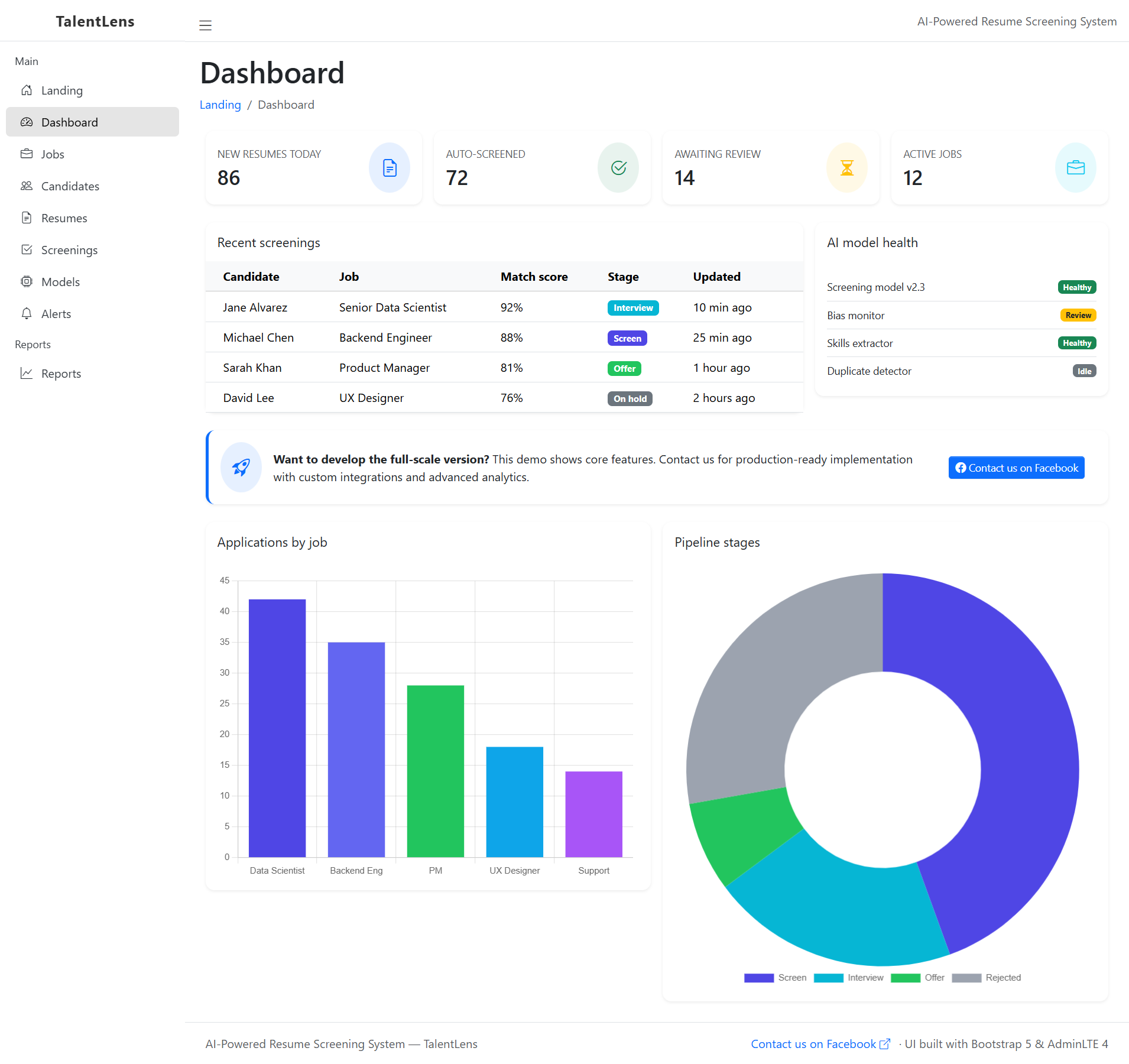
- Recruiter Dashboard
- Candidate Portal
- Benefits of Using an AI Resume Screening System
- Faster Hiring Process
- Reduced Manual Workload
- Improved Candidate Matching
- Better Hiring Accuracy
- Scalable Recruitment
- Real-World Use Cases
- Corporate Hiring
- Recruitment Agencies
- Government Employment Offices
- Educational Institutions
- Core System Modules
- 1. User Management Module
- 2. Job Management Module
- 3. Resume Processing Module
- 4. AI Screening Module
- 5. Interview Management Module
- 6. Reporting Module
- Technology Stack
- Frontend
- Backend
- Database
- AI and NLP Tools
- Security
- Addressing Concerns About AI in Hiring
- Avoiding Bias
- Human Oversight
- Transparent Criteria
- Future of AI in Recruitment
- Predictive Hiring Analytics
- Video Interview Analysis
- Skill-Based Assessments
- Chatbot Assistants
- Conclusion
Hiring the right people has always been one of the most important responsibilities of any organization. Whether it is a small business hiring its first employee or a large corporation recruiting hundreds of applicants each month, the process of reviewing resumes can be overwhelming. Human resource teams often spend hours, sometimes days, sorting through stacks of applications just to find a few qualified candidates.
In many cases, good applicants are overlooked simply because their resumes were not formatted the right way or were buried under hundreds of others. At the same time, recruiters may spend valuable time reviewing applications that clearly do not meet the basic requirements of the role.
This is where an AI-Powered Resume Screening System can make a real difference. By combining artificial intelligence with modern web technologies, organizations can automate the initial screening process, reduce manual workload, and focus more on selecting the best candidates instead of sorting through paperwork.
The Hiring Challenge in Today’s Digital World
Over the past decade, job applications have become easier to submit. While this is good for job seekers, it has created a new challenge for recruiters. A single job posting can receive hundreds or even thousands of applications within a short period of time.
Recruiters often face several common problems:
- Too many resumes to review manually
- Inconsistent evaluation between applicants
- Time-consuming shortlisting process
- Missed opportunities due to human fatigue or bias
- Delayed hiring decisions
When recruitment teams are overwhelmed, the quality of hiring decisions can suffer. The process becomes more about speed than accuracy, and that can lead to poor hiring outcomes.
What Is an AI-Powered Resume Screening System?
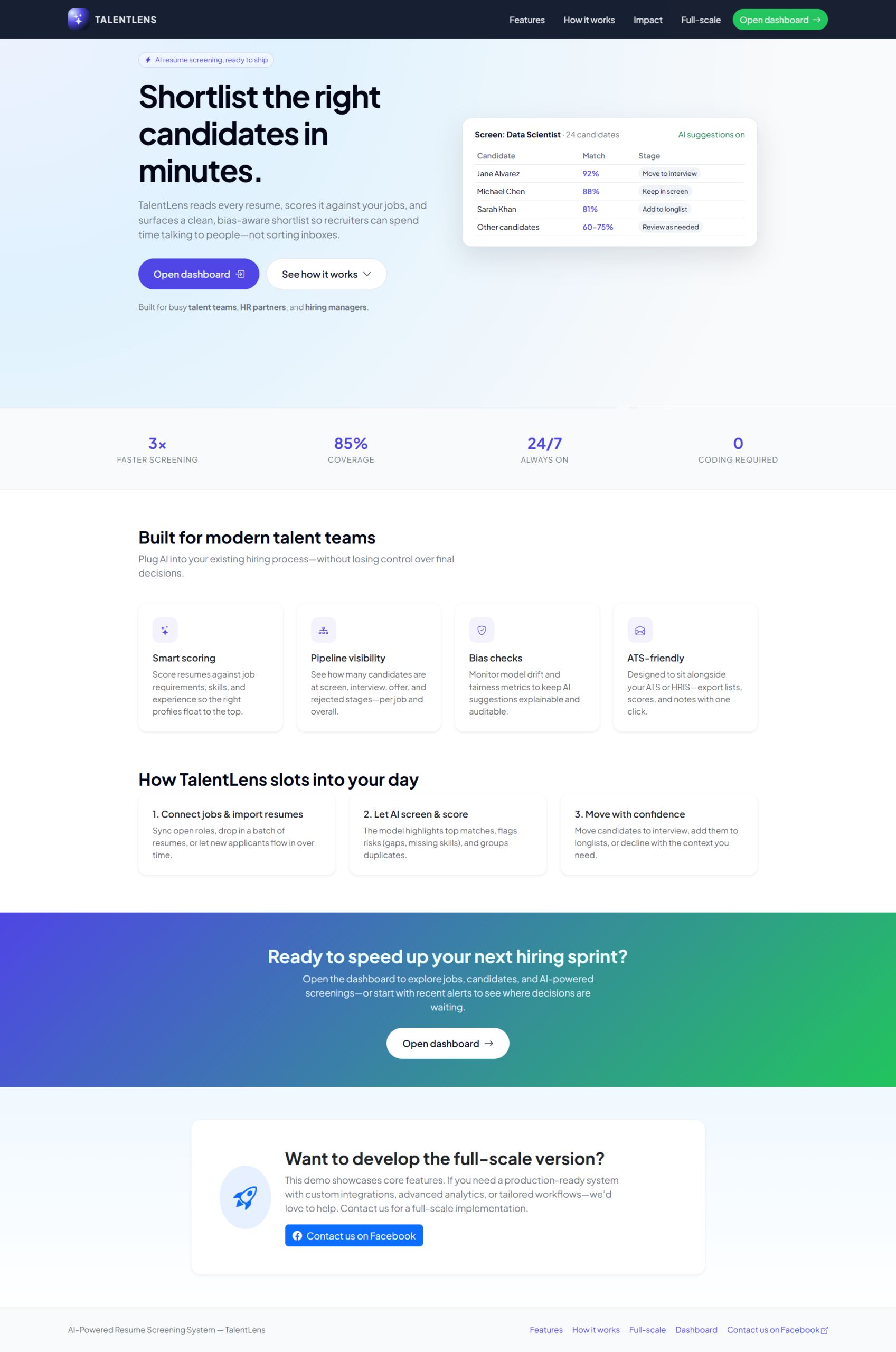
An AI-Powered Resume Screening System is a digital platform that uses artificial intelligence to analyze resumes and automatically identify the most suitable candidates for a job.
Instead of manually reading each resume, the system:
- Extracts information from submitted resumes
- Compares applicant qualifications to job requirements
- Scores or ranks candidates based on relevance
- Generates a shortlist for recruiters
The goal is not to replace human decision-making, but to assist recruiters by handling repetitive tasks and providing data-driven insights.
How the System Works
Although the internal logic may vary depending on the technology used, most AI resume screening systems follow a similar workflow.
Step 1: Job Posting
The recruiter creates a job listing within the system. This includes:
- Job title
- Required skills
- Education level
- Years of experience
- Preferred qualifications
These details form the basis for candidate evaluation.
Step 2: Resume Submission
Applicants submit their resumes through an online portal. The system accepts various formats such as:
- Word documents
- Text-based resumes
Step 3: Resume Parsing
The AI engine scans each resume and extracts key information, including:
- Personal details
- Work experience
- Education
- Skills
- Certifications
This process is known as resume parsing.
Step 4: Candidate Scoring
Once the data is extracted, the system compares the applicant’s profile with the job requirements. It then assigns a score based on:
- Skill relevance
- Experience level
- Educational background
- Keyword matches
Step 5: Shortlisting
The system generates a ranked list of candidates. Recruiters can then:
- Review top applicants
- Schedule interviews
- Provide feedback
- Move candidates to the next stage
This reduces the time spent on manual screening.
Key Features of an AI-Powered Resume Screening System
Automated Resume Parsing
The system reads and interprets resumes automatically, eliminating manual data entry.
Intelligent Candidate Ranking
Applicants are ranked based on how well they match the job requirements.
Customizable Screening Criteria
Recruiters can define specific criteria for each job position.
Recruiter Dashboard
A centralized dashboard allows HR teams to:
- View applicant rankings
- Track hiring progress
- Manage job postings
- Generate reports
Candidate Portal
Applicants can:
- Submit resumes
- Track application status
- Receive notifications
Benefits of Using an AI Resume Screening System
Faster Hiring Process
AI can analyze hundreds of resumes in minutes, significantly reducing screening time.
Reduced Manual Workload
Recruiters can focus on interviews and decision-making instead of sorting resumes.
Improved Candidate Matching
The system evaluates applicants based on consistent criteria.
Better Hiring Accuracy
Data-driven screening helps identify candidates who truly match the job requirements.
Scalable Recruitment
Organizations can handle large volumes of applications without increasing HR staff.
Real-World Use Cases
Corporate Hiring
Large companies can process thousands of applications for entry-level or technical positions.
Recruitment Agencies
Agencies can screen candidates faster and serve more clients efficiently.
Government Employment Offices
Public sector hiring can become more transparent and efficient.
Educational Institutions
Schools and universities can screen applicants for teaching or administrative roles.
Core System Modules
A typical AI-powered resume screening system includes the following modules:
1. User Management Module
- Recruiter and applicant accounts
- Role-based access control
- Profile management
2. Job Management Module
- Job posting creation
- Requirement settings
- Application deadlines
3. Resume Processing Module
- Resume uploads
- Parsing engine
- Data extraction
4. AI Screening Module
- Candidate scoring
- Ranking algorithms
- Shortlist generation
5. Interview Management Module
- Interview scheduling
- Candidate status tracking
- Feedback collection
6. Reporting Module
- Hiring statistics
- Candidate analytics
- Recruitment performance reports
Technology Stack
A modern AI-powered resume screening system can be built using the following technologies:
Frontend
- HTML5
- CSS3
- JavaScript
- Bootstrap
- AdminLTE dashboard template
Backend
- Python (for AI and NLP processing)
- PHP or Node.js (for system logic and APIs)
Database
- MySQL or PostgreSQL
AI and NLP Tools
- Natural Language Processing libraries
- Machine learning models for candidate scoring
Security
- SSL encryption
- Role-based access control
- Secure file uploads
Addressing Concerns About AI in Hiring
While AI offers many advantages, some organizations are concerned about fairness and transparency. These concerns are valid and should be addressed during system design.
Avoiding Bias
The system should be trained using diverse and unbiased datasets.
Human Oversight
AI should assist recruiters, not replace them. Final hiring decisions should always involve human judgment.
Transparent Criteria
Recruiters should be able to see how candidate scores are calculated.
By combining AI efficiency with human insight, organizations can achieve better hiring outcomes.
Future of AI in Recruitment
AI is expected to play an even larger role in recruitment in the coming years. Future systems may include:
Predictive Hiring Analytics
AI can predict candidate success based on historical data.
Video Interview Analysis
AI can analyze facial expressions, tone, and responses.
Skill-Based Assessments
Automated testing and evaluation of candidate skills.
Chatbot Assistants
AI chatbots can answer applicant questions and guide them through the hiring process.
Conclusion
An AI-Powered Resume Screening System offers a practical solution to one of the most time-consuming parts of recruitment. By automating resume analysis and candidate ranking, organizations can reduce manual workload, speed up hiring, and make more informed decisions.
Rather than replacing recruiters, the system acts as a digital assistant—handling repetitive tasks while allowing human professionals to focus on interviews, culture fit, and final selection.
As hiring continues to evolve in the digital age, AI-powered screening systems will become an essential tool for organizations that want to stay competitive, efficient, and fair in their recruitment processes.
You may visit our Facebook page for more information, inquiries, and comments. Please subscribe also to our YouTube Channel to receive free capstone projects resources and computer programming tutorials.
Hire our team to do the project.