AI Crop Yield Prediction System
Table of Contents
- AI Crop Yield Prediction System
- Leveraging Artificial Intelligence for Smarter Agricultural Decision-Making
- Introduction
- Project Overview
- Objectives of the AI Crop Yield Prediction System
- Key Features of the System
- Dashboard
- Data Collection Module
- AI Prediction Engine
- Crop Analysis and Forecasting
- Recommendations and Insights
- User Interface and Experience
- System Workflow
- Reports and Analytics
- Benefits of the AI Crop Yield Prediction System
- Future Enhancements
- Conclusion
Leveraging Artificial Intelligence for Smarter Agricultural Decision-Making
Introduction
Agriculture plays a vital role in food security, economic stability, and rural development. However, farmers and agricultural planners continue to face significant challenges in predicting crop yields accurately. Factors such as unpredictable weather patterns, climate change, soil variability, pest infestations, and inefficient resource allocation make traditional yield estimation methods unreliable and reactive.
In recent years, Artificial Intelligence (AI) has emerged as a powerful tool in modern agriculture. By analyzing large volumes of agricultural data, AI systems can identify patterns and trends that are difficult to detect through manual methods. One practical application of this technology is the AI Crop Yield Prediction System, which uses data-driven models to forecast crop yields and support informed agricultural decision-making.
This blog post presents an overview of the AI Crop Yield Prediction System, its objectives, key features, system workflow, and the benefits it brings to farmers, agricultural offices, and policymakers.
Project Overview
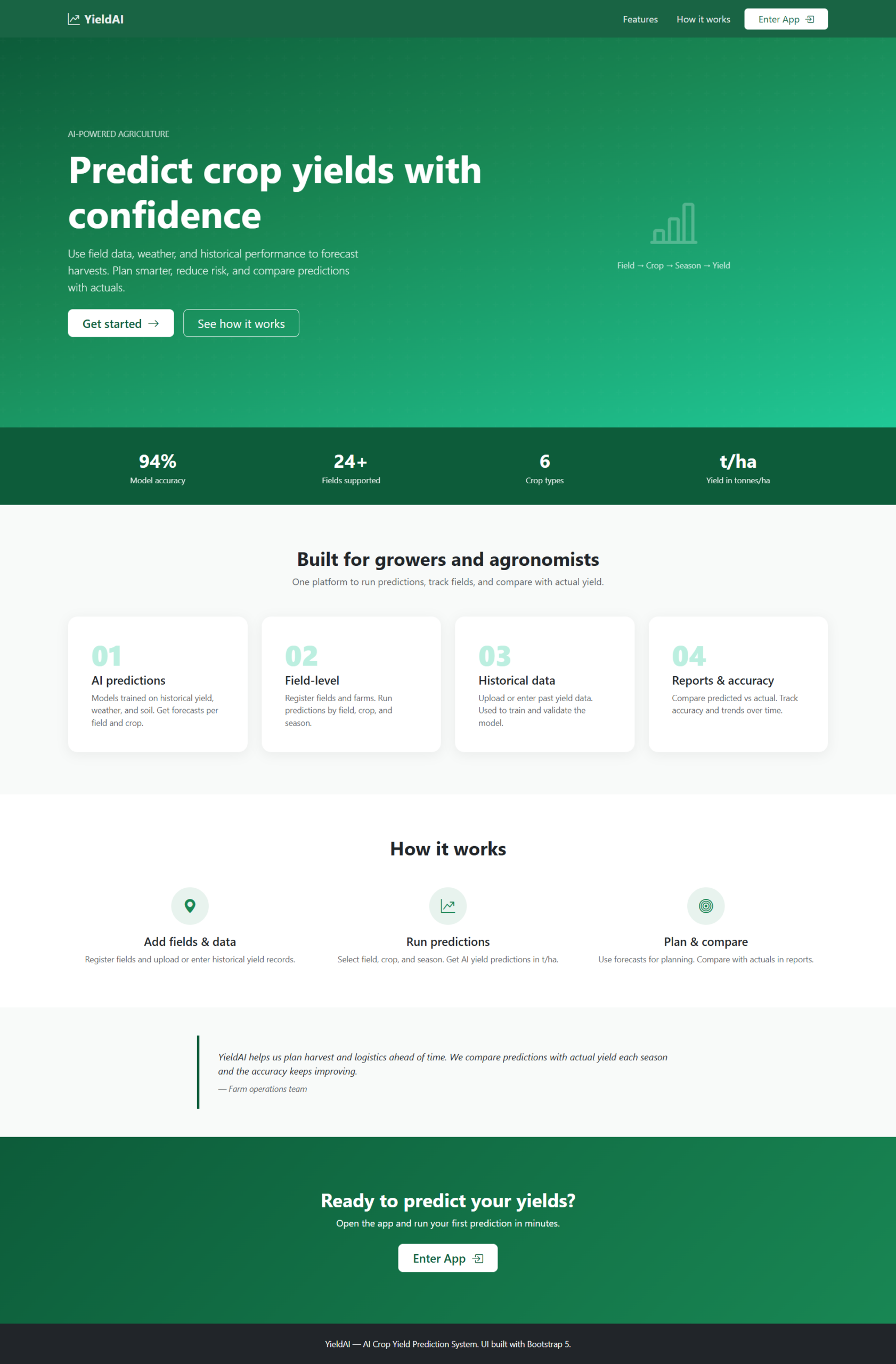
The AI Crop Yield Prediction System is a web-based agricultural decision support system designed to predict crop yields using artificial intelligence and historical data. The system integrates multiple data sources—such as weather, soil conditions, crop type, and historical yield records—to generate accurate yield forecasts for specific crops and seasons.
The system is intended for:
- Farmers and farm managers
- Agricultural officers and planners
- Researchers and analysts
- Local government units (LGUs) and agricultural agencies
By providing early and reliable yield predictions, the system helps stakeholders plan farming activities, manage risks, and optimize agricultural productivity.
Objectives of the AI Crop Yield Prediction System
The system was developed with the following objectives:
- Predict crop yield accurately using AI and machine learning models
- Assist farmers in planning planting, irrigation, and harvesting schedules
- Reduce uncertainty caused by weather and climate variability
- Improve resource allocation (water, fertilizer, labor)
- Support food security planning and agricultural policy decisions
- Promote data-driven and sustainable farming practices
Key Features of the System
Dashboard
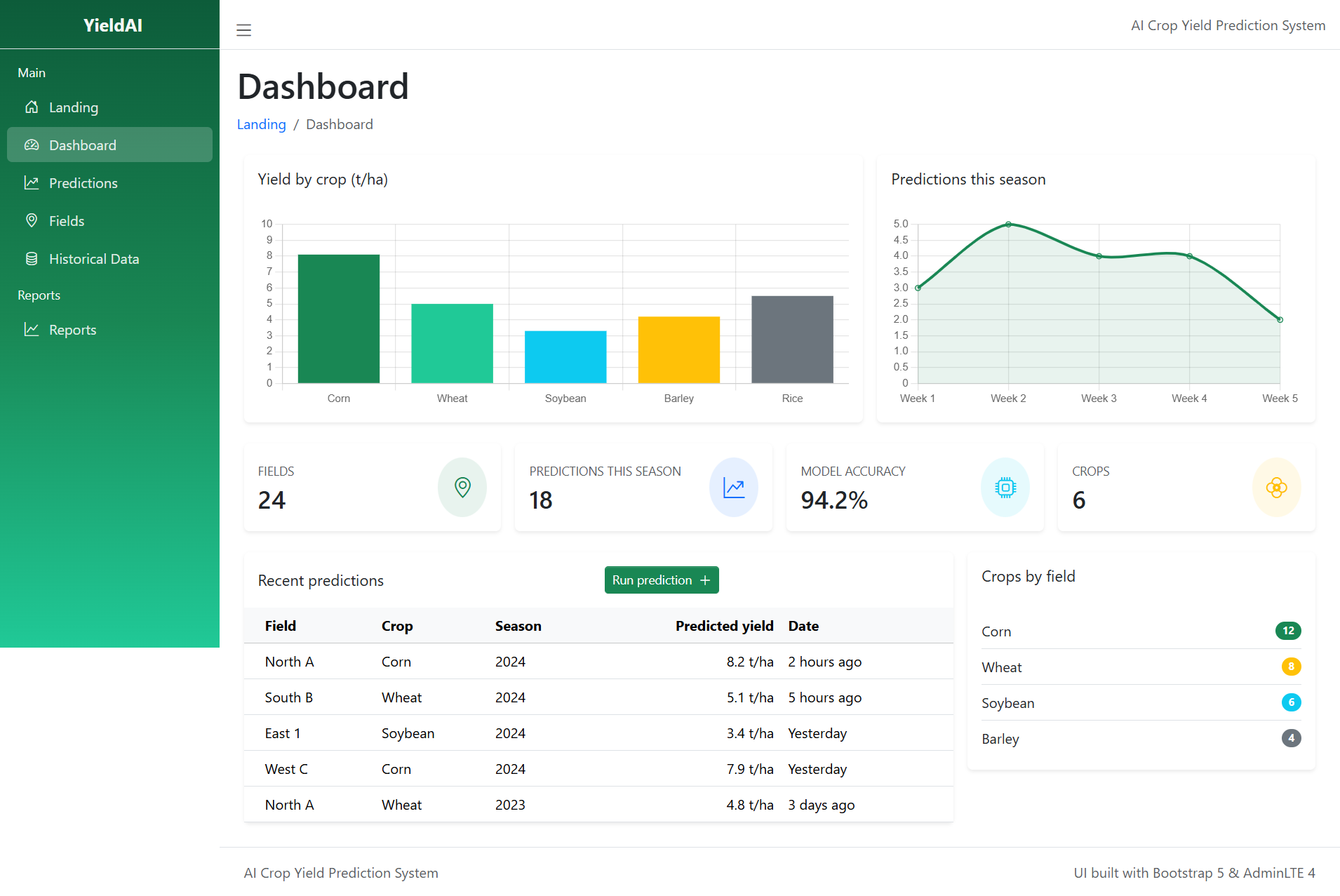
The Dashboard serves as the central overview of the system. It presents summarized insights and real-time indicators related to crop yield predictions.
Key dashboard elements include:
- Predicted yield versus historical yield comparisons
- Crop performance indicators
- Weather condition summaries
- Seasonal trend charts and graphs
- Alerts for potential low-yield risks
This visual overview allows users to quickly assess current and future agricultural conditions.
Data Collection Module
Accurate prediction depends heavily on quality data. The Data Collection Module is responsible for gathering and managing all relevant input data required by the AI model.
Supported data inputs include:
- Weather data (rainfall, temperature, humidity)
- Soil data (soil type, moisture level, nutrients)
- Crop type and variety
- Planting date and season
- Historical crop yield records
Data can be entered manually or imported from external sources, ensuring flexibility and adaptability to different agricultural environments.
AI Prediction Engine
The AI Prediction Engine is the core component of the system. It processes collected data using machine learning algorithms to generate yield predictions.
Key capabilities include:
- Analysis of historical and real-time data
- Identification of relationships between environmental factors and yield
- Prediction of expected yield per crop and season
- Confidence indicators to show prediction reliability
The use of AI allows the system to continuously improve accuracy as more data becomes available.
Crop Analysis and Forecasting
The Crop Analysis & Forecasting module provides detailed insights into predicted crop performance.
Features include:
- Yield forecasts per crop type and planting season
- Comparative analysis across different time periods
- Visualization of yield trends and patterns
- Identification of high-risk and high-potential crops
These insights help users make informed decisions before and during the growing season.
Recommendations and Insights
Beyond prediction, the system also acts as a decision support tool. Based on AI analysis, it can generate actionable recommendations such as:
- Suggested planting schedules
- Fertilizer and nutrient recommendations
- Irrigation planning guidance
- Risk alerts for drought or low yield probability
These recommendations enable farmers and planners to take proactive measures rather than reactive responses.
User Interface and Experience
The system’s frontend is built using Bootstrap and AdminLTE, ensuring a clean, responsive, and modern user interface.
UI design principles include:
- Simple and intuitive navigation
- Clear data visualization using charts and tables
- Mobile-responsive layout for field accessibility
- Consistent design across all modules
The sidebar menu typically includes:
- Dashboard
- Data Input
- Yield Prediction
- Crop Analysis
- Reports
- Settings
This layout ensures ease of use for both technical and non-technical users.
System Workflow
The AI Crop Yield Prediction System follows a structured workflow:
- Data Input and Validation
Agricultural data is collected and validated for accuracy. - AI Model Processing
The prediction engine analyzes the data using trained machine learning models. - Yield Prediction Generation
The system produces yield forecasts with confidence indicators. - Visualization and Reporting
Results are displayed through dashboards, charts, and reports. - Decision Support and Recommendations
Users receive insights and actionable recommendations.
This workflow ensures a seamless and transparent prediction process.
Reports and Analytics
The Reports and Analytics module provides historical and predictive insights that support long-term planning.
Available reports include:
- Seasonal yield prediction reports
- Crop performance summaries
- Comparative yield analysis by year or region
- Exportable reports in PDF or Excel format
These reports are valuable for monitoring trends, evaluating policies, and supporting agricultural research.
Benefits of the AI Crop Yield Prediction System
The system offers multiple benefits to stakeholders:
- Improved accuracy in crop yield forecasting
- Reduced risks related to weather and climate variability
- Better farm planning and cost efficiency
- Enhanced decision-making through data analytics
- Support for sustainable and climate-resilient agriculture
- Increased agricultural productivity and food security
Future Enhancements
To further improve system performance, future enhancements may include:
- Integration with IoT sensors and satellite imagery
- Real-time weather API integration
- Advanced deep learning models
- Mobile application support
- Geographic Information System (GIS) mapping
These enhancements will strengthen the system’s predictive capabilities and usability.
Conclusion
The AI Crop Yield Prediction System demonstrates how artificial intelligence can transform traditional agriculture into a smarter, data-driven practice. By combining AI-powered prediction with a user-friendly web interface, the system enables farmers, agricultural officers, and policymakers to make informed decisions that improve productivity, sustainability, and food security.
As agriculture continues to face global challenges, AI-based solutions like this system play a critical role in shaping the future of smart farming and agri-tech innovation.
You may visit our Facebook page for more information, inquiries, and comments. Please subscribe also to our YouTube Channel to receive free capstone projects resources and computer programming tutorials.
Hire our team to do the project.