Digital Land Record Management System
Table of Contents
- Digital Land Record Management System
- Modernizing Land Administration Through Secure and Efficient Digital Solutions
- Introduction
- Project Overview
- Objectives of the System
- Key Features of the Digital Land Record Management System
- Dashboard
- Land Record Management Module
- Land Registration Module
- Ownership Transfer Module
- Land Search and Verification
- Document Management System
- User Interface and Experience
- UI Design Highlights
- System Workflow
- Reports and Analytics
- Security and Data Protection
- Benefits of the Digital Land Record Management System
- Future Enhancements
- Conclusion
Modernizing Land Administration Through Secure and Efficient Digital Solutions
Introduction
Land ownership records are among the most important public documents in any country. They determine property rights, support economic development, enable infrastructure planning, and ensure legal protection for landowners. However, in many regions, land records are still maintained using manual or semi-digital systems. These traditional approaches often lead to inefficiencies, data inconsistencies, delayed processing, and even disputes over land ownership.
Manual land record systems are prone to issues such as misplaced documents, unauthorized alterations, slow retrieval times, and lack of transparency. Citizens may spend days or even weeks processing land-related transactions, while government offices struggle to manage large volumes of paperwork.
To address these challenges, the Digital Land Record Management System was developed. This web-based system provides a centralized, secure, and efficient platform for managing land records, transactions, and ownership data. By digitizing land records and automating processes, the system improves transparency, accuracy, and service delivery.
Project Overview
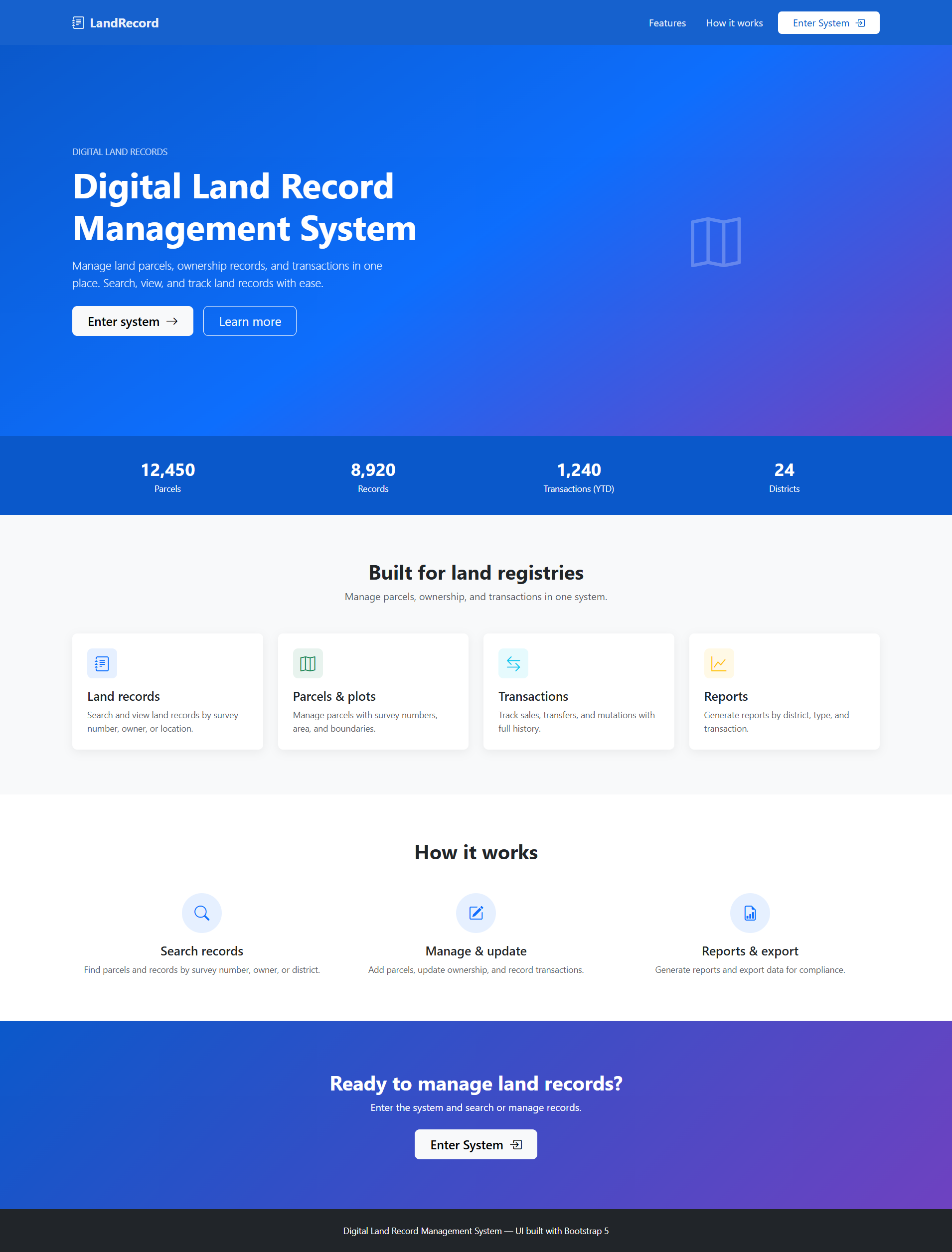
The Digital Land Record Management System is a web-based information system designed to store, manage, and process land ownership records in a secure digital environment. The system replaces manual record-keeping methods with an integrated platform that allows users to access, update, and verify land data efficiently.
The system is designed for:
- Landowners and citizens
- Land registration offices
- Local government units (LGUs)
- Surveyors and land administrators
- Legal and property professionals
Its primary function is to digitize land records and streamline processes such as registration, verification, transfer of ownership, and reporting. The system ensures that all land-related information is stored securely and can be accessed quickly when needed.
Objectives of the System
The development of the Digital Land Record Management System is guided by the following objectives:
- Digitize and centralize land ownership records
- Reduce manual paperwork and administrative delays
- Improve accuracy and reliability of land data
- Enhance transparency in land transactions
- Provide fast and secure access to land information
- Support dispute resolution through accurate record tracking
- Improve public service delivery in land administration
Key Features of the Digital Land Record Management System
Dashboard
The Dashboard serves as the central overview of system activities. It provides administrators and staff with real-time insights into land-related transactions and records.
Dashboard features include:
- Total registered land parcels
- Pending land registration requests
- Recent land transactions
- Ownership transfer statistics
- Graphical reports and summaries
This overview helps administrators monitor system activity and manage workloads effectively.
Land Record Management Module
The Land Records module is the core component of the system. It stores all information related to land parcels and ownership details.
Key functionalities include:
- Registration of new land parcels
- Storage of ownership details
- Land location and boundary information
- Parcel identification numbers
- Search and filter capabilities
This module ensures that all land records are organized, accurate, and easily retrievable.
Land Registration Module
The Land Registration module allows users or administrators to register new land parcels into the system.
Features include:
- Digital submission of land registration forms
- Upload of supporting documents (titles, surveys, IDs)
- Verification of ownership details
- Approval and rejection workflows
This module simplifies the registration process and reduces manual paperwork.
Ownership Transfer Module
The Ownership Transfer module manages changes in land ownership due to sale, inheritance, donation, or legal transfer.
Core features include:
- Submission of ownership transfer requests
- Document verification and approval
- Automatic updating of land ownership records
- Transaction history tracking
This feature ensures transparency and traceability of ownership changes.
Land Search and Verification
The Land Search feature allows authorized users to verify land records quickly.
Capabilities include:
- Search by parcel number, owner name, or location
- Instant display of ownership details
- Status of the land (active, disputed, transferred)
- Document preview options
This module improves public access to land information and reduces fraudulent transactions.
Document Management System
The system includes a Document Management Module for storing and organizing digital copies of land-related documents.
Features include:
- Upload and storage of legal documents
- Secure document access
- Version control for updated files
- Document preview and download
This reduces the risk of lost or damaged records.
User Interface and Experience
The system’s frontend is built using Bootstrap and AdminLTE, ensuring a clean, modern, and responsive interface.
UI Design Highlights
- Role-based dashboards (admin, staff, citizen)
- Clear navigation through sidebar menus
- Mobile-responsive layout
- User-friendly forms for data entry
Typical sidebar menu structure:
- Dashboard
- Land Records
- Registration
- Ownership Transfer
- Search & Verification
- Documents
- Reports
- Settings
The interface is designed to be intuitive, allowing users with minimal technical knowledge to operate the system effectively.
System Workflow
The Digital Land Record Management System follows a structured workflow:
- Land Registration
New land parcels are submitted for registration. - Document Verification
Administrators verify submitted documents and ownership details. - Approval Process
Approved records are stored in the central database. - Ownership Transfer (if applicable)
Transfer requests are processed and recorded. - Search and Verification
Users can access and verify land information. - Reporting and Monitoring
Administrators generate reports and monitor system activity.
This workflow ensures consistency, transparency, and efficiency.
Reports and Analytics
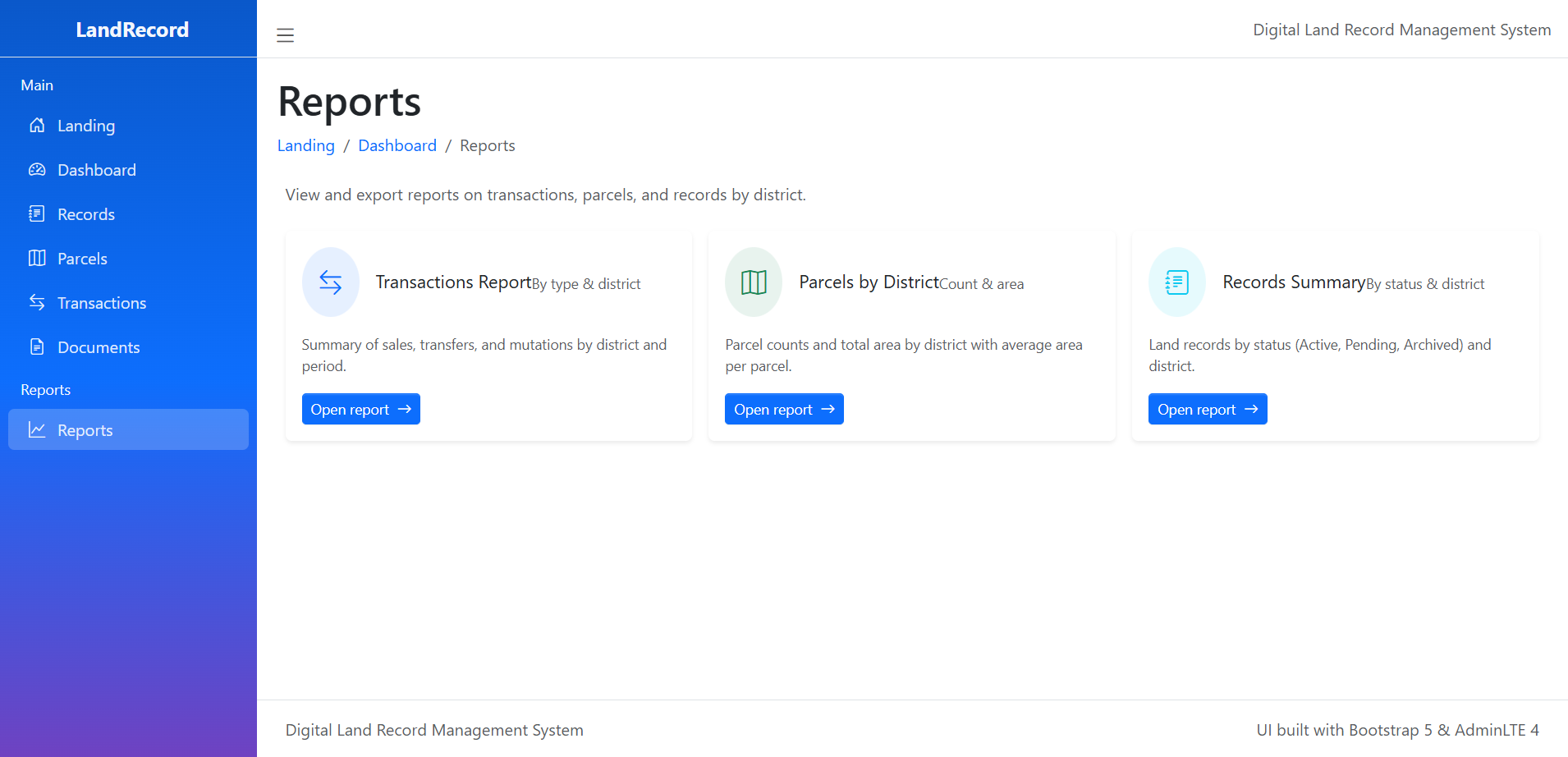
The Reports module provides insights into land-related activities and transactions.
Available reports may include:
- Land registration reports
- Ownership transfer summaries
- Parcel distribution by area
- Transaction history reports
Reports can be exported for administrative use and decision-making.
Security and Data Protection
Since land records are sensitive legal documents, the system incorporates strong security measures.
Key security features include:
- Secure user authentication
- Role-based access control
- Data encryption for stored records
- Audit trails for all transactions
- Regular data backups
These measures ensure data integrity and protect against unauthorized access or manipulation.
Benefits of the Digital Land Record Management System
Implementing the system offers several advantages:
- Faster land registration and transfer processes
- Reduced paperwork and administrative burden
- Improved accuracy and reliability of land data
- Enhanced transparency in land transactions
- Better access to land information for citizens
- Reduced risk of disputes and fraud
- Scalable architecture for future expansion
These benefits contribute to more efficient land administration and improved public service delivery.
Future Enhancements
Potential future improvements to the system include:
- Integration with Geographic Information Systems (GIS)
- Mobile application for field verification
- Online payment integration for land fees
- Blockchain-based land record security
- Integration with national land registries
These enhancements can further modernize land administration systems.
Conclusion
The Digital Land Record Management System represents a significant step toward modernizing land administration. By replacing manual processes with a secure and efficient digital platform, the system improves transparency, accuracy, and service delivery.
Through centralized records, automated workflows, and user-friendly interfaces, the system ensures that land information is reliable, accessible, and protected. As governments and organizations continue to embrace digital transformation, systems like this play a critical role in promoting efficiency, trust, and economic development.
You may visit our Facebook page for more information, inquiries, and comments. Please subscribe also to our YouTube Channel to receive free capstone projects resources and computer programming tutorials.
Hire our team to do the project.