Crowd Behavior Analysis Using PoseNet: A Complete Guide for Real-Time Monitoring and AI Applications
Table of Contents
- Crowd Behavior Analysis Using PoseNet: A Complete Guide for Real-Time Monitoring and AI Applications
- Understanding Crowd Behavior Analysis
- What is PoseNet?
- How PoseNet Supports Crowd Behavior Detection
- 1. Detecting Multiple Poses Simultaneously
- 2. Tracking Motion Across Frames
- 3. Understanding Joint and Limb Patterns
- 4. Identifying Abnormalities
- System Architecture Using PoseNet for Crowd Behavior Analysis
- Key Features Extracted from PoseNet for Behavior Analysis
- 1. Pose Keypoints and Angles
- 2. Crowd Density & Proximity
- 3. Motion Vectors
- 4. Collective Behavior Patterns
- 5. Abnormal Postures
- Real-World Applications of Crowd Behavior Analysis Using PoseNet
- 1. Public Safety & Surveillance
- 2. Event Management (Sports, Concerts, Festivals)
- 3. Smart Cities
- 4. Disaster and Emergency Response
- 5. Retail & Commercial Analytics
- 6. Healthcare & Elderly Monitoring
- Challenges and Limitations
- 1. Occlusion
- 2. Low-Light Environments
- 3. Camera Angles
- 4. Computational Requirements
- 5. Behavior Classification Accuracy
- 6. Privacy Concerns
- How to Improve PoseNet-Based Crowd Behavior Systems
- 1. Using Stronger Pose Models
- 2. Combining PoseNet with Other Models
- 3. Adding Temporal Models
- 4. Data Augmentation and More Training Data
- 5. Smoothing and Filtering Keypoints
- Sample Implementation Overview (Beginner Friendly)
- Conclusion
Monitoring and understanding crowd behavior has become increasingly important in today’s fast-moving environments—whether for public safety, smart cities, event management, or emergency response. With the rise of deep learning and computer vision, automated approaches now offer accurate, scalable, and real-time insights into how people move and interact within a crowd.
One powerful tool for achieving this is PoseNet, a human pose estimation model capable of detecting joint keypoints in images and videos. In this blog post, we explore how PoseNet can be used for crowd behavior analysis, how it works, its applications, challenges, and even how you can start implementing it.
Understanding Crowd Behavior Analysis
Crowd behavior analysis involves studying group movement, actions, and interactions to identify normal and abnormal patterns. Typical crowd behaviors include:
- Normal flow – people walking in one direction
- Congestion – slow movement or clustering
- Panic – fast, chaotic movement
- Violence or aggressive behavior – sudden changes in pose patterns
- Anomalies – falling, collapsing, scattering unexpectedly
Traditional crowd monitoring relied heavily on CCTV footage and human observers. But humans make mistakes, get tired, and cannot process dozens of live streams simultaneously.
AI-powered systems, however, can:
- Monitor multiple streams 24/7
- Detect anomalies instantly
- Provide objective and consistent evaluations
- Generate insights that help prevent accidents and improve safety
This is where PoseNet becomes a valuable asset.
What is PoseNet?
PoseNet is a deep learning model that estimates human body pose by detecting 17 keypoints, including:
- Nose, eyes, ears
- Shoulders, elbows, wrists
- Hips, knees, ankles
PoseNet works well on:
- Single-person and multi-person scenes
- Browser-based and mobile applications
- Real-time crowd footage
- Low to medium computational hardware
Because PoseNet can detect multiple people at once, it becomes a foundation for analyzing how individuals behave within a crowd.
How PoseNet Supports Crowd Behavior Detection
In crowd scenes, PoseNet helps extract structured information about human movement by:
1. Detecting Multiple Poses Simultaneously
It identifies all individuals in the camera frame, making it possible to measure density and crowd flow.
2. Tracking Motion Across Frames
By comparing keypoints in consecutive frames, the system can analyze:
- Direction of movement
- Speed
- Sudden shifts
- Group formations
3. Understanding Joint and Limb Patterns
Specific behaviors reflect specific poses, such as:
- Falling (sudden vertical drop in hip/torso points)
- Running (increased stride angles)
- Fighting (rapid, chaotic arm movements)
- Panic (fast and unpredictable pose changes)
4. Identifying Abnormalities
Unusual patterns—like scattered movement or mass rushing—can be automatically flagged for security personnel.
System Architecture Using PoseNet for Crowd Behavior Analysis
A typical AI pipeline for PoseNet-based crowd behavior analysis involves:
- Video Input
- CCTV camera
- Drone footage
- Live event feed
- Pose Estimation (PoseNet)
- Detects keypoints for each person
- Generates pose data (coordinates, confidence scores)
- Feature Extraction
- Movement vectors
- Joint angles
- Crowd density
- Inter-person distance
- Behavior Classification Layer
- ML model (SVM, Random Forest)
- Deep learning model (LSTM, CNN-LSTM)
- Rule-based anomaly detection
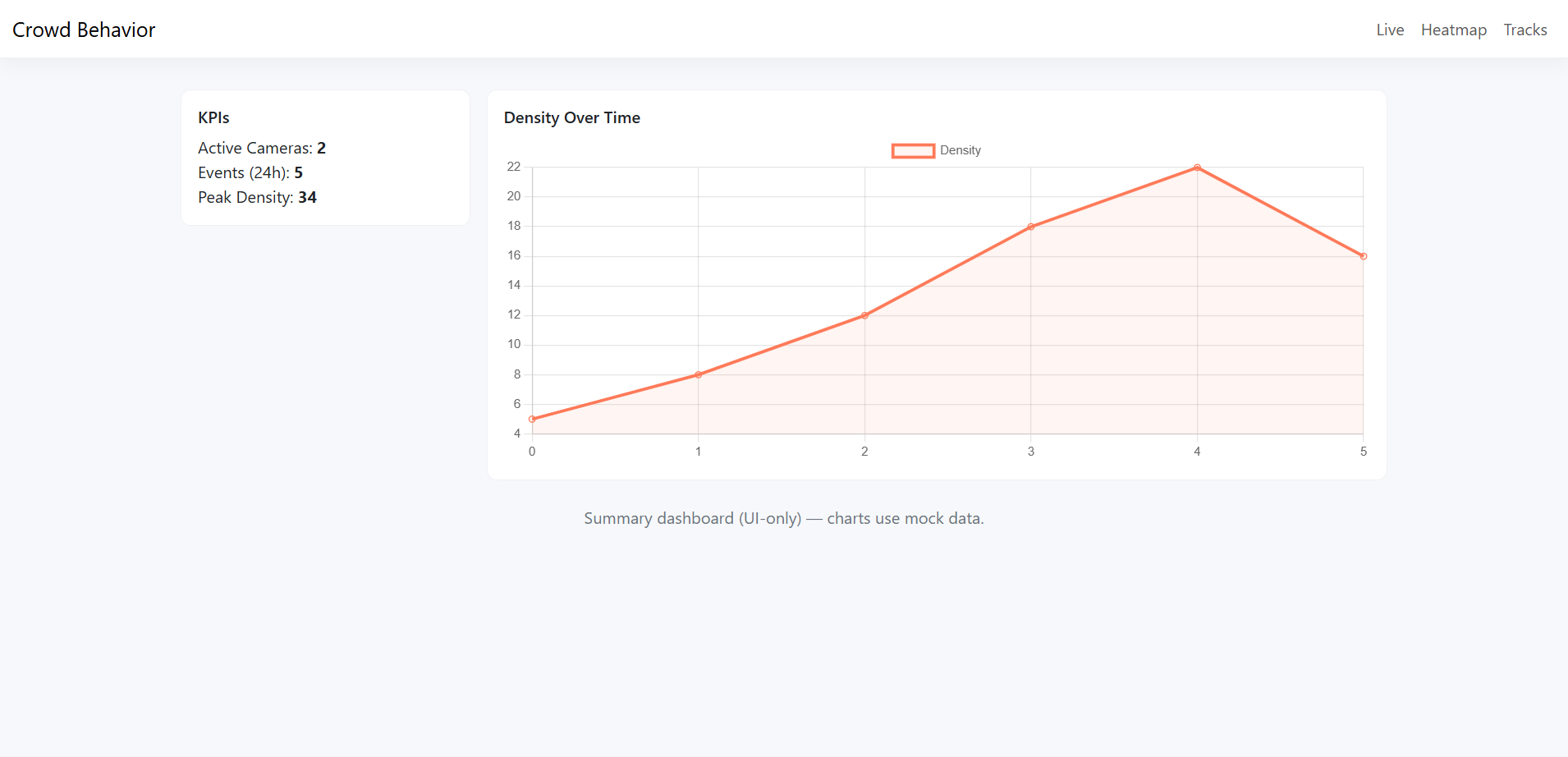
- Alert System and Dashboard
- Heatmaps
- Notifications (SMS, email, alarm)
- Real-time monitoring UI
- Data Storage
- Archival for training and analytics
Key Features Extracted from PoseNet for Behavior Analysis
1. Pose Keypoints and Angles
These are primary data for understanding body movement.
2. Crowd Density & Proximity
Useful for detecting congestion and unsafe crowding.
3. Motion Vectors
Direction, velocity, and acceleration of individuals.
4. Collective Behavior Patterns
Detects coordination or chaotic dispersal.
5. Abnormal Postures
Such as:
- Collapse
- Slipping
- Aggressive gestures
This way, PoseNet provides a clear picture of the crowd’s condition at any moment.
Real-World Applications of Crowd Behavior Analysis Using PoseNet
1. Public Safety & Surveillance
Automatic detection of:
- Fights
- Panic situations
- Sudden crowd movement
- Abnormal gathering
Helps law enforcement react faster.
2. Event Management (Sports, Concerts, Festivals)
Monitor:
- Crowds at entry/exit points
- Potential stampede triggers
- Fan movement and flow patterns
3. Smart Cities
Used in:
- Transport hubs
- Markets
- Plazas
for congestion control and public safety.
4. Disaster and Emergency Response
During earthquakes, fires, or floods:
- Detect falling or injured people
- Track evacuation patterns
- Identify bottlenecks
5. Retail & Commercial Analytics
Managers can:
- Track foot traffic
- Identify slow zones
- Optimize store layout
6. Healthcare & Elderly Monitoring
Detect falls in hospitals, nursing homes, or assisted-living areas.
Challenges and Limitations
While PoseNet is powerful, there are constraints:
1. Occlusion
Crowds often overlap, making pose estimation difficult.
2. Low-Light Environments
Accuracy decreases with poor lighting.
3. Camera Angles
Top-down or extreme-angle cameras may reduce detection quality.
4. Computational Requirements
Real-time processing for big crowds may need GPU acceleration.
5. Behavior Classification Accuracy
PoseNet gives keypoints, but behavior detection still needs ML classifiers.
6. Privacy Concerns
AI crowd monitoring should comply with ethical standards and local laws.
How to Improve PoseNet-Based Crowd Behavior Systems
Improvement strategies include:
1. Using Stronger Pose Models
Such as MoveNet, OpenPose, or HRNet for higher accuracy.
2. Combining PoseNet with Other Models
- YOLO for person detection
- DeepSORT for person tracking
- Optical Flow for motion tracking
- Gait analysis for identity tracking
3. Adding Temporal Models
Using LSTM or transformer-based models to classify behavior patterns over time.
4. Data Augmentation and More Training Data
Crowd datasets improve system performance dramatically.
5. Smoothing and Filtering Keypoints
Kalman filters or moving averages reduce pose jitter.
Sample Implementation Overview (Beginner Friendly)
Below is a simplified workflow:
// Example: Running PoseNet in TensorFlow.js

const net = await posenet.load({
  architecture: 'MobileNetV1',
  outputStride: 16,
  inputResolution: 257,
  multiplier: 0.75
});

const pose = await net.estimateMultiplePoses(videoElement, {
  flipHorizontal: false,
  maxDetections: 10
});

// Extract movement
pose.forEach(person => {
  person.keypoints.forEach(point => {
    console.log(point.position); // x, y per frame
  });
});
From here, you can:
- Track keypoints across frames
- Compute movement vectors
- Apply rules or ML models to classify behavior
This is the starting point of a complete crowd behavior detection system.
Conclusion
PoseNet brings powerful, real-time pose estimation capabilities that can significantly enhance crowd monitoring and public safety systems. By extracting human pose and movement information from video streams, PoseNet enables deeper analysis of crowd dynamics—detecting anomalies, preventing accidents, and providing crucial insights for smarter and safer environments.
As AI and computer vision technologies evolve, integrating PoseNet with advanced tracking and behavior classification models will continue to transform how we understand and manage crowd behavior.
You may visit our Facebook page for more information, inquiries, and comments. Please subscribe also to our YouTube Channel to receive free capstone projects resources and computer programming tutorials.
Hire our team to do the project.